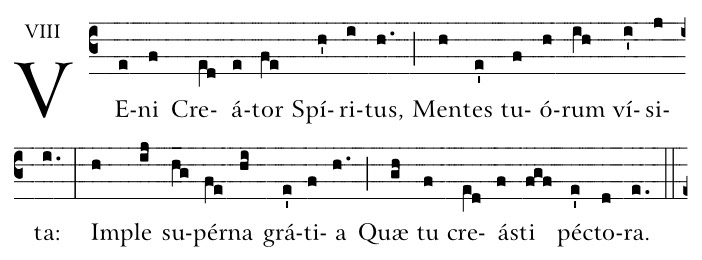
One of the questions I sometimes challenge myself with is, if music is itself making a theological contribution, and not only the texts which might be set to music, what theological difference is there to singing the same text to a different tune? This is a parallel version of a set of questions often asked by translators, rendering words and sentences from one language to another with inevitable choices about emphases and interpretations.
I am thinking now of a medieval hymn, sung at vespers from Low Sunday (the Sunday after Easter) until Ascension day in some uses, including the Sarum Rite and some Gallican traditions. The text is attributed to Fulbert, Bishop of Chartres from 1006 to 1028, and appears in a number of manuscript sources from the eleventh century, which implies it became popular quite quickly. There are some textual variants, of which the most interesting seems to be the second line, in which a Greek word (μέλος) is given a Latin genitive form (Meli) to refer to the new songs of sweetness which are to be sung by the choir of the New Jerusalem; hymni appears in some manuscripts, presumably favoured for being more Latin.
Set as chant it is a strophic hymn (in which each verse repeats the same melody) and encompasses a full octave. Perhaps it will not be surprising, therefore, that we in the Twenty-First Century may also know this text as a hymn ‘Ye Choirs of New Jerusalem’, often sung to a tune named St Fulbert in acknowledgment of his text. That is in a translation by Robert Campbell which fits the ‘common metre’ and there are therefore many other well-known hymn tunes to which the same words could be set. There is an alternative translation by John Mason Neale, several of whose other translations of medieval hymnody are still in use, which is in the nearly-as-common ‘long metre’.
And yet, despite its flexibility, the version I know best – Campbell’s translation to the tune named after St Fulbert – seems apt to me, and I think I would struggle to hear those words to a different tune. My feelings and putative struggles, however, are surely mere habituation, not theology. So we return to the question I started with. If my supposition is that the music itself makes a theological contribution to the text somehow, how is that? What difference does a different tune make?
I have some thoughts, but I am going to leave the question hanging for now: analytics tell me this blog gets some readers – not masses, to be sure, but not none either – and I wonder whether I can invite some responses and comments. While I enjoy writing these weekly posts, it would be even better if some conversation might be provoked. Any thoughts of your own?
 Theology in Music
Leave a comment