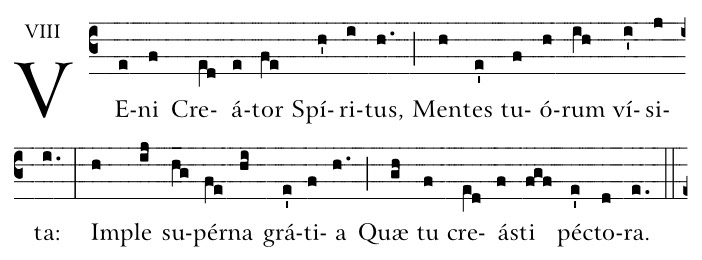
Beginning on 17 December the church by tradition begins to chant the Great Advent Antiphons, known as the O Antiphons, at the beginning and end of the Magnificat in liturgical offices using Gregorian plainchant. There are such antiphons for each liturgical feast, season and Sunday of the year. In the seven days from the 17th to the 23rd of December, the antiphons follow a set pattern, which is why they are grouped together. Each begins with an ‘O’ of invocation, and goes on to name one of the titles of Christ, with a brief description; invocation turns to petition, and the request is always that he ‘come’.
The text as a whole translates as follows:
First – O wisdom, which issued from the mouth of the most high, reaching from end to end, powerfully and sweetly disposing all things: come to teach us the way of prudence.
Second – O Adonai [אֲדֹנָי, which is Hebrew for Lord], and leader of the house of Israel, who appeared to Moses in the fire of the burning bush, and gave him the Law at Sinai: come to redeem us with you arm outstretched.
Third – O root of Jesse, who stands as a sign for the peoples, over whom kings will hold their mouths, over whom nations will plead: come to deliver us with no more delay.
Fourth – O key of David, and sceptre of the house of Israel, who opens and no one will shut, closes and no one will open: come and lead out from prison the prisoner sitting in darkness.
Fifth – O Morningstar [or rising sun; most literally ‘eastern’, with eastern light implied] brightness of eternal light, and sun of justice: come and enlighten those who sit in darkness and in the shadow of death.
Sixth – O King of the nations, and their desire, and the cornerstone, who makes both one: come and save the man whom thou hast formed of clay.
And seventh – O Emmanuel [עִמָּנוּאֵל ‘God is with us’], our king and lawgiver, the expectation of the nations, and their saviour: come to save us, Lord our God.
As you will have understood, there is a rich lot of imagery in these texts; if you hadn’t heard them before and yet nevertheless find them to be a little familiar, you might notice that they form the basis and inspiration for the more well known Advent hymn ‘O come O come Emmanuel.’
My first additional observation is that the sequence in which they come gives a sort-of telescoping effect with the first, the invocation of eternal wisdom acting in creation, the second suggesting the Mosaic covenant, the third and fourth bringing us to the family of King David, the Fifth and Sixth to the person of Christ in glory, and finally to the God-with-us of the incarnation.
The second observation is that if we take the titles of Christ used in each, and read them as an acrostic in reverse order, we find a Latin phrase which is a hidden response from Christ to the church praying and looking for his coming. So, we end with Emmanuel, spelt in its Latin form with an E; penultimate, we take the R of Rex Gentium – king of the nations; and before that the O of Oriens, or morning star. Ero is a future tense from the Latin verb to be, so it means ‘I will be’.
Continuing backwards through the set we take the C from Clavis David – key of David; the R from Radix Jesse – root of Jesse; the A of Adonai; and the S of Sapientia, wisdom, thereby spelling the Latin Cras meaning ‘tomorrow’ or by extension ‘soon’ (incidentally the etymological root of our word procrastination). Thus as we call for the coming of Christ over seven days leading up to the great feast of the incarnation, there is encoded within that call the promise that ‘soon I will be’.
Assured of that promise, let us pray: Maranatha! Come, Lord Jesus.
 Theology in Music
Leave a comment